
We replace timing belts and timing chains at our workshop in Lasnamäe. We base the replacement interval on the manufacturer’s schedule for your engine, not on average figures. We replace a belt together with its tensioner and idlers, and a stretched chain as a complete kit.
Priisle tee 18, Tallinn
Mon–Fri: 09:00–18:00
Cars and minibuses of all makes
What timing belt or chain replacement includes
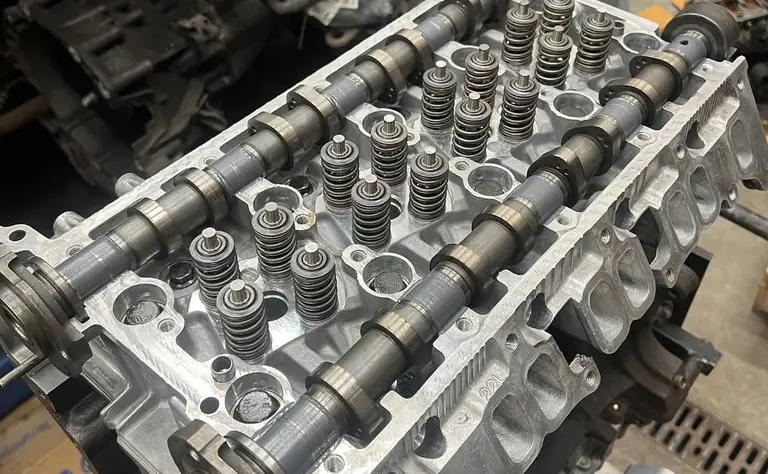
The timing drive links the crankshaft to the camshafts so that the valves open at exactly the right moment. What the job involves depends on the engine and on which parts are worn.
Schedule by VIN
We use the VIN to identify the engine, the type of timing drive and the replacement interval. Manufacturers revise their schedules, so we check the current data rather than an old service book.
Belt, tensioner and idlers
We replace the belt together with the tensioner and idlers. Their bearings wear along with the belt, and a seized idler can destroy a new belt.
Water pump and oil seals
If the water pump is driven by the timing belt, it is usually replaced at the same time, so that the drive does not have to be taken apart twice. We also replace leaking oil seals: oil destroys a conventional belt.
Chain as a complete kit
We replace a stretched chain together with the tensioner and guides, and the sprockets too if they are worn. A new chain fitted with old parts will not last long.
Valve timing
We set the valve timing using the manufacturer’s procedure and tighten the bolts to the specified torque. Then we turn the crankshaft and check that the timing marks line up.
Check after replacement
We start the engine and check that it runs properly, with no leaks and no engine control unit fault codes.
When to replace the timing belt or chain
A belt usually snaps without warning, so for a belt the main guide is the service schedule. Chain wear usually shows in advance. Book a visit if any of the following applies:
The scheduled interval is due. A belt is replaced by mileage or by age, whichever comes first, even if it looks intact.
You do not know when the belt was replaced. With no record of the replacement, there is nothing to count the interval from. It is safer to replace the belt and start the count afresh.
Rattling on a cold start. A metallic rattle in the first few seconds after starting is a typical sign of a stretched chain or a weak tensioner.
Shaft position fault codes. Codes P0016–P0019 mean that the camshaft and crankshaft are out of sync. The cause may be the chain, the cam phaser or a sensor — car diagnostics will help pin it down.
Oil or coolant on the drive. A leaking oil seal or water pump ruins the belt: oil and coolant quickly break down the rubber. The belt is replaced and the leak is fixed.
Noise or leaks around the drive. A whirring noise from the timing belt side or coolant seeping from under the belt cover are signs of worn idlers or a worn water pump.
The oil pressure warning light is on. On engines with a wet belt, belt debris can clog the oil pickup. Stop and do not continue driving.
The engine stalled and will not start. If the starter also sounds different, the belt may have snapped. Do not try to start the engine again — call a tow truck.
How a timing belt differs from a timing chain
Whether an engine has a belt or a chain is the engine manufacturer’s choice, and the two are maintained differently.
The main differences:
- a belt is replaced to the manufacturer’s schedule, by mileage and by age, because rubber ages even if the car is rarely driven;
- a chain often has no fixed replacement interval, but over time it stretches and the tensioner and guides wear, so it is replaced according to its condition;
- a chain depends more on the oil: infrequent oil changes and a low oil level speed up its wear;
- on many engines (interference engines), the pistons strike the valves if the belt snaps or the chain jumps a tooth. You then need engine repair, which costs far more than a timely replacement.
There is no single interval
The belt replacement interval depends on the specific engine, and the manufacturer may change it over the years of production. That is why we take into account:
- the engine and the model year — from the VIN;
- the mileage and the date of the last replacement — from the service book or invoice;
- operating conditions: short trips, city driving, long periods of idling, towing a trailer.
Figures such as “every 60,000–100,000 km” do not suit every car: on some engines the interval is longer, on others it is considerably shorter.
Wet belts: 1.2 PureTech and 1.0 EcoBoost
- with frequent short trips, fuel gets into the oil and the belt wears faster: it delaminates, and the debris clogs the oil pickup strainer and the oil passages;
- as a result, the oil pressure drops, and on some 1.2 PureTech versions the brake servo vacuum pump suffers too;
- the manufacturers have already shortened the replacement intervals for these belts, so follow the current schedule for your VIN;
- on the 1.2 PureTech, the manufacturer requires the belt to be checked at every service: its width is measured through the oil filler neck;
- use only oil with the manufacturer’s approval and change it on time — see the Oil change page for details;
- the third-generation 1.2 PureTech, fitted since 2023, has a chain instead of a belt. We will check which timing drive your car has from its VIN.
If the oil pressure warning light or the “Stop” light comes on, switch off the engine and do not continue driving: have the car taken to the workshop by tow truck.
How timing belt or chain replacement works
First we work out what needs replacing and when, then we agree on the work, and only then do we take the drive apart.
Schedule and inspection
We use the VIN to identify the engine and its service schedule. We inspect the drive for leaks, noisy idlers and signs of wear. If there are signs of chain wear, we check the fault codes and the shaft position data.
Estimate and approval
We determine which kit the engine needs and agree the scope of work and the cost with you before the repair begins.
Replacement
We replace the belt or chain with the tensioner and idlers, and the water pump and oil seals if needed. We set the valve timing using the manufacturer’s procedure.
Final check
We turn the crankshaft, check the timing marks and start the engine. We make sure there are no leaks, unusual noises or fault codes.
Frequently asked questions about timing belt and chain replacement
How much does timing belt or chain replacement cost?
The cost depends on the engine: how hard it is to reach the timing drive, whether it has a belt or a chain, and whether the water pump and oil seals need replacing. Current prices are on the Prices page. We agree the cost with you before the repair begins.
How often should the timing belt be replaced?
There is no single interval. The manufacturer sets it for each engine, by mileage and by age, whichever comes first. Even within one model, different engines have different intervals. We will check the schedule for your car from its VIN.
Does a timing chain need replacing?
On many engines the chain has no fixed interval, but it does not last forever: over time it stretches, and the tensioner and guides wear. The signs are a rattle on a cold start and fault codes showing that the shafts are out of sync. The chain is then replaced as a complete kit.
What happens if the timing belt snaps?
The engine stalls. On many engines the pistons then strike the open valves: the valves bend and the cylinder head may be damaged. Do not try to start the engine again — have the car taken to the workshop by tow truck.
Should the water pump be replaced with the belt?
If the water pump is driven by the timing belt, then as a rule, yes. It wears along with the idlers, and if it fails later, the drive has to be taken apart again. If the pump is driven some other way, we decide based on the inspection.
Why replace the belt by age if the mileage is low?
Rubber ages over time, even when the car is standing still. That is why the manufacturer gives the interval in years as well as in kilometres; the belt is replaced at whichever comes first.
How do I book a timing belt or chain replacement?
Fill in the form on this page or call +372 5552 7985. Give your registration number or VIN and, if you know them, the mileage and the date when the belt or chain was last replaced.
Book a timing belt or chain replacement
Fill in the short form below — we will find a time that suits you.
Arrange a service visit today
Enter your vehicle details and a convenient time — we will contact you and confirm your booking.